
War Powers 101
Understanding, and then talking

It’s crazy how little people know about the War Powers Resolution of 1973.
It seems most Americans (and, frankly, a lot of pundits + Ilhan Omar and her ilk) think the President needs Congress’s permission before he can use military force anywhere in the world.
History books and common sense be damned, let’s take a look at the specifics…
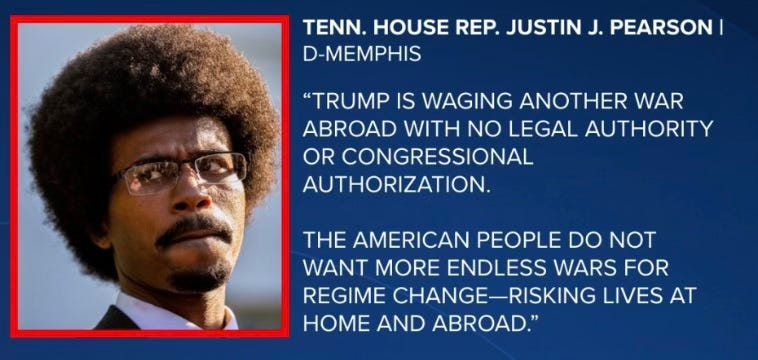
Here’s the actual rule:
The President has the constitutional authority as Commander-in-Chief to introduce U.S. Armed Forces into hostilities or situations where imminent involvement in hostilities is clearly indicated. He is required to notify Congress within 48 hours. Then, unless Congress declares war or passes specific statutory authorization, the troops must be withdrawn within 60 calendar days (extendable by another 30 days if the President certifies it’s necessary for safe withdrawal).
That’s it. “Legal Authority” with no prior vote required. No “Congressional Authorization” required. No automatic “violation” the moment strikes begin.
Key Provisions: Word-for-Word Where It Matters
Passed over President Nixon’s veto (of course, cuz he loved bombs) on November 7, 1973, in direct response to Vietnam and the secret bombing of Laos & Cambodia, the Resolution’s stated purpose is “to fulfill the intent of the framers… and ensure that the collective judgment of both the Congress and the President will apply” to the use of force.
The critical sections:
Section 3 (Consultation): “The President in every possible instance shall consult with Congress before introducing United States Armed Forces into hostilities…”
Section 4 (Reporting): Within 48 hours the President must send a written report to the Speaker of the House and the President pro tempore of the Senate detailing (A) the circumstances, (B) the constitutional and legislative authority, and (C) the estimated scope and duration.
Section 5(b) (Termination): Within 60 days after the report is submitted (or required to be submitted), the President “shall terminate any use” of the forces unless Congress has declared war or enacted “specific statutory authorization.” The clock can be extended 30 days for safe withdrawal.
Section 5(c): Congress can also direct removal at any time by concurrent resolution (the so-called “legislative veto” mechanism, whose constitutionality has been debated).
Presidents of both parties have always submitted these reports “consistent with” the Resolution rather than “pursuant to” it, to preserve their view that the law unconstitutionally limits commander-in-chief power. But the reporting and 60-day clock have become the practical operating rules.
How This Applies to the Current U.S. / Iran Situation
On February 28, 2026, U.S. forces (in coordination with Israel) conducted precision strikes inside Iran targeting ballistic missile sites, air defenses, maritime capabilities, command-and-control nodes, and senior Iranian leadership.
President Trump submitted the required War Powers notification to Congress on Monday, March 2, citing the constitutional authority of the President and describing the action as a response to an “untenable” threat to the United States and its allies. Administration officials also briefed congressional leaders of both parties (the “Gang of Eight”) prior to the operation.
As of today - literally four or five days into the operation - the 60-day clock has barely started ticking. The withdrawal deadline (absent congressional authorization) would not arrive until late April or early May 2026 at the earliest. Therefore [and listen closely, hosts of The View] as of today, the President has not violated the War Powers Resolution or exceeded the statutory framework.
Important Nuances + Edge Cases Most People Miss
“Declaration of war” is not the only off-ramp. Congress can pass a specific Authorization for Use of Military Force (AUMF) instead — exactly what happened for Afghanistan (2001) and Iraq (2002). The Resolution explicitly accepts that route.
The Constitutionality debate is real and unresolved. Section 2(c) of the Resolution asserts that presidential power is limited to (1) declared war, (2) specific statutory authorization, or (3) a national emergency created by attack on the United States. Every president since Nixon has called parts of the law unconstitutional. Courts have largely stayed out (political-question doctrine). So when critics say the strikes are “unconstitutional,” they are usually arguing the broader separation-of-powers point, not that the 48-hour/60-day rule itself was broken.
Congress still has tools — but they are politically difficult. A concurrent resolution under Section 5(c) could theoretically force withdrawal. Bipartisan resolutions have already been introduced (e.g., H.Con.Res.38 and new efforts this week). But passing one and overriding a veto requires two-thirds majorities in both chambers — something Congress has never successfully done against a president of either party in a hot conflict.
Historical precedent is consistent. Obama’s Libya campaign (2011) continued past 60 days without new authorization (he argued it wasn’t “hostilities”). Trump’s 2017–2018 Syria strikes followed the same notification playbook. Biden’s 2021–2024 operations against Iran-backed militias did too. The pattern: presidents notify, Congress complains, the 60-day clock runs, and almost never forces withdrawal.
Why This Matters Beyond Partisan Talking Points
Whether you support the Iran operation, oppose it, or are still making up your mind, the War Powers Resolution is one of the few concrete mechanisms we have left to force a national conversation about war. It doesn’t prevent presidents from acting quickly when they believe the country faces imminent danger - but it does put a 60-day fuse on unlimited escalation.
Right now, that fuse is lit and the clock is running. Congress is scheduled to vote on War Powers measures as soon as this week. The public debate over the next two months will determine whether this remains a limited campaign or becomes something larger.
The framers wanted collective judgment. The War Powers Resolution is Congress’s attempt to get it. Whether it works this time is now up to the 119th Congress. To date, nothing has been violated - other than Nancy Pelosi’s pride and her stock portfolio.
Understanding the actual law - instead of the viral slogans and political misinformation - is the only way citizens can adequately hold both branches accountable.
So… it’s simple… know what you’re talking about before you start talking about it.
You know where to find me, just don’t drone-strike me…
Todd